
We’ve all been there. You’re driving down Federal Highway, maybe heading to the beach or rushing to a meeting, when that little amber glow appears on your dashboard. The dreaded “Check Engine” light. Your heart sinks a little because that light is the ultimate mystery. Is it a loose gas cap, or is your engine about to give up the ghost?
In the old days, a mechanic would pop the hood, listen for a knock, smell the exhaust, and give you a diagnosis based on years of grease-stained experience. Today, things are different. Your car is essentially a rolling supercomputer, packed with dozens of sensors that monitor everything from the air entering your engine to the temperature of your transmission fluid.
When that light comes on, the first thing any reputable mechanic Deerfield Beach FL will suggest is an engine diagnostic. But do you really need it? Or is it just a way for shops to charge you more? Today, we’re pulling back the curtain on modern car sensors and the truth about diagnostics.
The “Nervous System” of Your Vehicle
Think of your car’s sensors as its nervous system. Just like your body sends signals to your brain when you touch something hot, your car sends signals to the Engine Control Unit (ECU) when something isn’t quite right. These sensors are constantly “talking,” making thousands of adjustments per second to keep your car running smoothly.
When one of these sensors detects a reading that falls outside of the “normal” range, it flags the ECU. The ECU then stores a “trouble code” and illuminates that light on your dash. This is where the confusion starts for many drivers.
The light doesn’t tell you exactly what is wrong; it tells you where to start looking. Without proper engine diagnostics Deerfield Beach, you’re essentially playing a high-stakes game of “guess and check” with your wallet.

The Problem: The Guessing Game is Expensive
Imagine your car starts stuttering at stoplights. You think, “Maybe it’s the spark plugs.” You spend money to replace them, but the problem persists. Next, you try a new fuel filter. Still nothing. By the time you actually find the culprit: perhaps a faulty mass airflow sensor: you’ve spent hundreds of dollars on parts you didn’t need.
This “parts cannon” approach is the most expensive way to maintain a vehicle. It causes unnecessary downtime, which is a nightmare if you rely on your car for work or manage a local business. For those managing a company fleet, this kind of trial-and-error can devastate your bottom line. We’ve seen businesses lose thousands because they tried to skip the diagnostic phase and ended up replacing perfectly good components.
At Life Line Automotive, we believe in fixing it right the first time. Our comprehensive auto repair services in Deerfield Beach, FL start with accurate data, not guesses.
The Truth About Those “Free” Code Scans
You’ve probably seen the signs at big-box auto parts stores: “Free Code Retrieval!” It sounds like a great deal, right? While these tools can pull the basic code (like P0420 for a catalytic converter issue), they don’t tell you the why.
A code for a “lean oxygen sensor” doesn’t always mean the sensor is bad. It could mean you have a vacuum leak, a clogged fuel injector, or an exhaust leak. If you just replace the sensor because the code reader said so, you’re treating the symptom, not the disease.
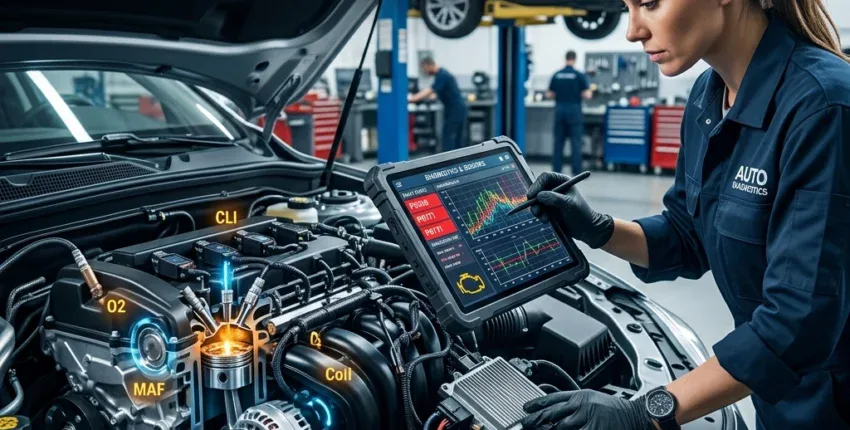
Professional engine diagnostics Deerfield Beach go much deeper. We use high-end scanners that show “live data” streams. We can see exactly what the sensors are seeing in real-time. This allows us to pinpoint the root cause, whether it’s a mechanical failure or an electrical glitch. It’s the difference between a home thermometer and a full hospital MRI.
How Modern Sensors Protect Your Assets
It might feel like these sensors are just there to annoy you, but they are actually your car’s best defense against a total meltdown. Here are a few key sensors and what they are actually doing for you:
- Oxygen (O2) Sensors: These monitor your exhaust to see if the engine is burning too much fuel or too little. A bad O2 sensor can drop your fuel economy by 40%.
- Mass Airflow (MAF) Sensor: This tells the engine how much air is coming in so it can add the right amount of fuel. If this is off, your car might stall or lose power.
- Knock Sensors: These are “ears” for your engine. They listen for internal vibrations that could lead to catastrophic engine failure. If they hear a knock, they adjust the engine timing instantly to save the motor.
- Coolant Temperature Sensor: This is the most critical. If it detects overheating, it can trigger “limp mode” to prevent your engine from melting down.
By paying attention to these sensors through regular diagnostics, you’re not just fixing a light; you’re protecting one of your biggest financial assets. This is especially true for businesses where fleet maintenance saves time and money in the long run.

The South Florida Factor: Salt Air and Electronics
Living in Deerfield Beach is beautiful, but it’s tough on cars. We’ve written before about how salt air near the coast affects your vehicle, and sensors are no exception.
Salt air can cause corrosion in electrical connectors. A sensor might be perfectly fine, but a corroded wire or a salty connection can send a “garbage” signal to the computer. A professional diagnostic includes checking the integrity of the wiring and the connectors, not just the part itself. This is why local expertise from a mechanic Deerfield Beach FL is so valuable; we know exactly how the local environment messes with your car’s electronics.
Minimizing Downtime: The Proactive Approach
If you’re a busy professional or a parent, the last thing you have time for is a breakdown on I-95. A proactive diagnostic scan during your regular maintenance: like when you come in for timely oil changes: can catch “pending” codes. These are issues the computer has noticed but hasn’t yet deemed serious enough to turn on the light.
Catching a failing sensor during a routine check-up means you can schedule the repair on your own terms. You aren’t stuck waiting for a tow truck on a Tuesday morning. We even offer free valet pickup and drop-off to make sure your day isn’t interrupted by necessary maintenance.
Is It Ever Okay to Ignore the Light?
The short answer? No.
Even if the car “feels fine,” an active check engine light usually means the car is no longer operating at peak efficiency. It might be dumping extra fuel into the cylinders, which can eventually clog your catalytic converter: a repair that costs thousands. Or, it could be ignoring a minor transmission slip that will lead to a full rebuild if left unchecked.
Think of it like this: If your business’s bank account was leaking $10 every day, you’d want to know why, right? Ignoring a sensor issue is essentially letting money leak out of your tailpipe every mile you drive.

The Life Line Automotive Promise: Trust and Transparency
We know that “engine diagnostics” can sometimes sound like a vague term used to pad a bill. At Life Line Automotive, we’re a family-run business. We treat your car like it belongs to our own family. When we run a diagnostic, we don’t just hand you a bill for a part. We show you the data. We explain why the sensor failed and what we can do to fix the root cause.
We are so confident in our diagnostics and our repairs that we offer a two-year/24,000-mile warranty. We want you to have peace of mind knowing that when we clear that light, it’s staying off for the right reasons.
Whether you’re an individual driver or a business looking for reliable fleet repair services in Deerfield Beach, FL, we are here to be your strategic partner in vehicle health.
Don’t Wait for the Breakdown
Modern car sensors aren’t a conspiracy to get you into the shop; they are a sophisticated tool designed to keep you safe and your car efficient. When you understand the “truth” about these sensors, you realize that an engine diagnostic isn’t an expense: it’s an investment in reliability.
If that light is glowing on your dash, or if your car just doesn’t feel as “peppy” as it used to, don’t leave it to chance. The “worst-case scenario” of a stalled engine in the middle of a busy intersection is a stress you don’t need.
Ready to get the truth about what your car is trying to tell you? Book an appointment with us today. Let our family take care of yours, and let’s keep your vehicle on the road where it belongs.